
About All Tours From Cairo ToursFrom Sharm El SheikhFrom Dahab ToursSinai & St. Catherine ToursSunrise ToursHike Tours Directions Hours & Fees
Find Tours 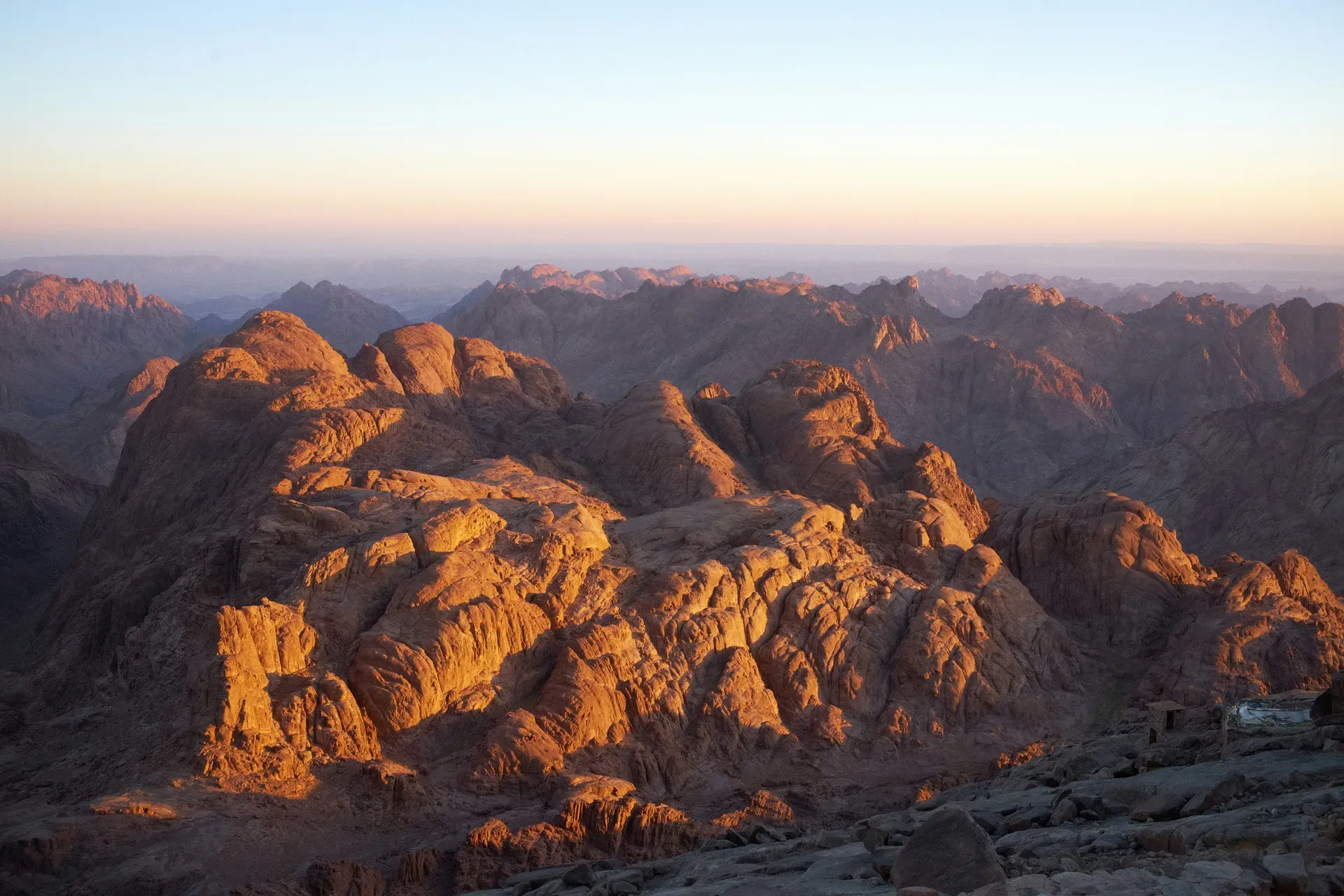
Mount Sinai — Jabal Musa, the Mountain of Moses — is a 2,285-metre granite peak in Egypt's Sinai Peninsula, revered by Jews, Christians and Muslims as the place Moses received the Ten Commandments. A night climb to its summit for sunrise, followed by a visit to the 6th-century monastery at its foot, has been the classic Sinai experience for centuries.
Mount Sinai — Jabal Musa, "Mountain of Moses," in Arabic — is a 2,285-metre granite peak in south-central Egypt's Sinai Peninsula, 3 km from the town of Saint Catherine and roughly 50 km from the Red Sea. Jews, Christians and Muslims all revere it as the mountain where Moses received the Ten Commandments, a tradition fixed here since at least the 4th century. Whatever you make of the identification, the physical facts hold: two routes climb to the summit, one gentle and one brutally steep, and people have walked them since the earliest recorded pilgrimage in 381 AD.
The classic visit is a night climb. You leave the trailhead between 1 and 2 AM with a compulsory Bedouin guide, gain the summit by 4 or 5, and wait in the cold until dawn — around 6 AM the light catches Mount Catherine and the entire granite massif turns gold. Then you walk down and straight into Saint Catherine's Monastery, Justinian's 6th-century fortress at the mountain's foot, which has housed a monastic community without interruption for over 1,400 years.
Numbers worth knowing: the round trip covers 11.5 km with 700 m of climbing and takes 3–4 hours. Most visitors arrive on overnight tours from Sharm el-Sheikh (230 km, about a 3-hour drive) or Dahab (130 km, 2 hours). March–May and October–November give you clear skies and tolerable temperatures; June–August, with 37–45°C at the base, is a slog and best skipped.
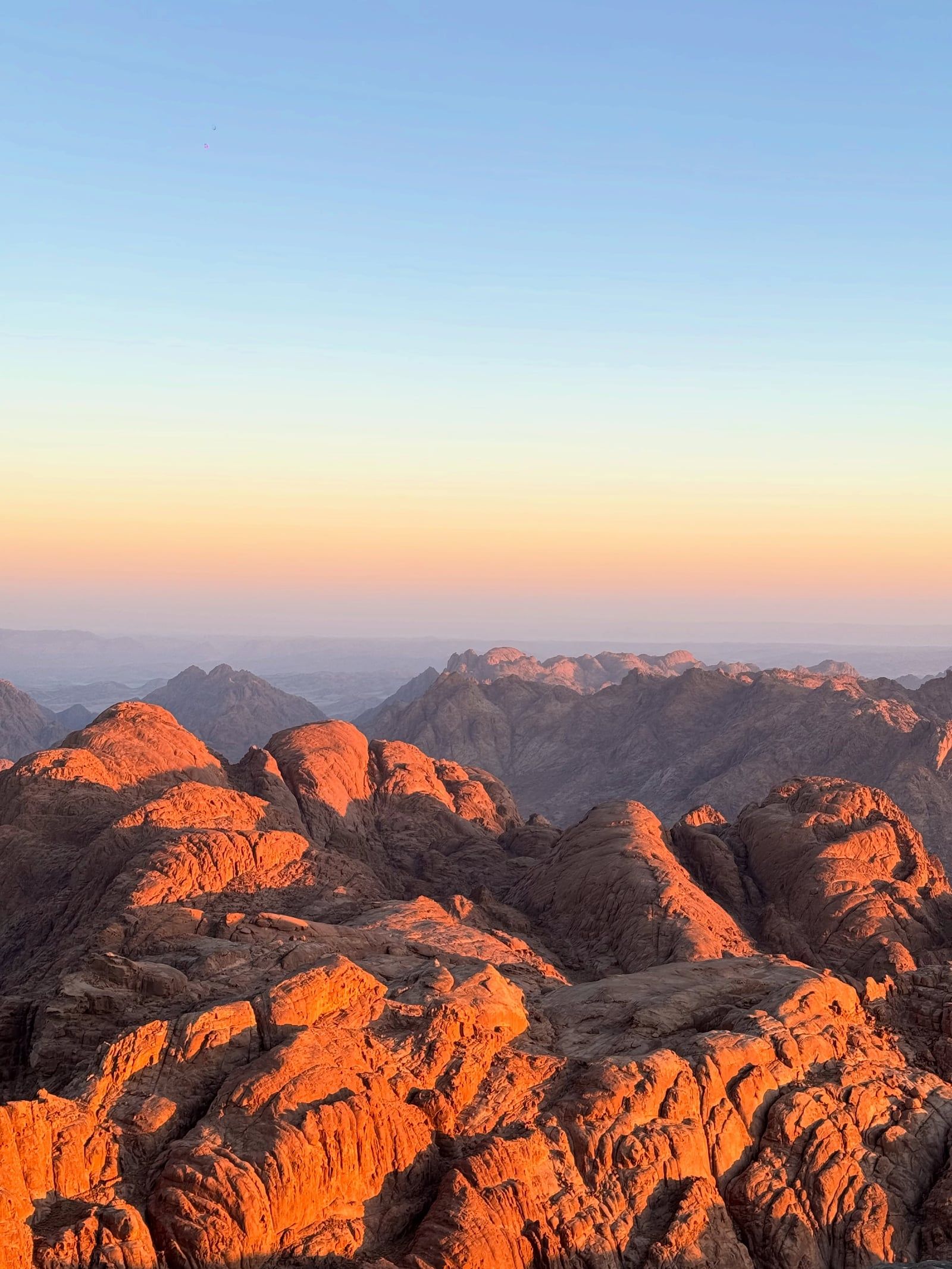
The rock under your boots is ancient. Mount Sinai's alkaline granite crystallized 600–550 million years ago in the Neoproterozoic era, part of the Arabian-Nubian Shield, and geologists still come to study its ring-complex structure. Humans arrived almost impossibly late by comparison.
Christian hermits settled the Sinai highlands by the 4th century, chasing isolation, and the earliest recorded pilgrimage to the mountain dates to around 381 AD. Chapels stood on the summit from that era. Sometime in the 6th–7th centuries a repentant monk carved the Steps of Repentance — 3,750 stone steps laid by hand from the valley toward the top, with 750 of them clamped between granite walls on the final stretch. They're still the direct route today, and pilgrims still climb them.
Between 548 and 565 CE, the Byzantine Emperor Justinian I built a fortress monastery at the mountain's base. Thick walls, a basilica, the enclosure around what tradition holds is the Burning Bush — that original building is Saint Catherine's Monastery, and monks have lived inside it continuously for more than 1,400 years. It's the world's oldest Christian monastery still operating in its original function. Its library holds roughly 3,500 ancient manuscripts and 2,000 Byzantine icons, and it was here that the Codex Sinaiticus, one of the oldest surviving Bibles, was discovered. A 12th-century mosque later joined the chapel on the summit, so a single peak now carries both a church and a mosque.
The modern chapters brought recognition and then friction. Egypt declared the surrounding 60,100 hectares a nature protectorate in 1988, and UNESCO inscribed the Saint Catherine Area as a World Heritage Site in 2002. Then in May 2025 an Egyptian court ruled the monastery's land state property. The monks shut the gates in protest; after negotiations between Egypt and Greece, the monastery reopened to visitors. A final legal settlement is still pending — so check the monastery's status before you build a trip around it.
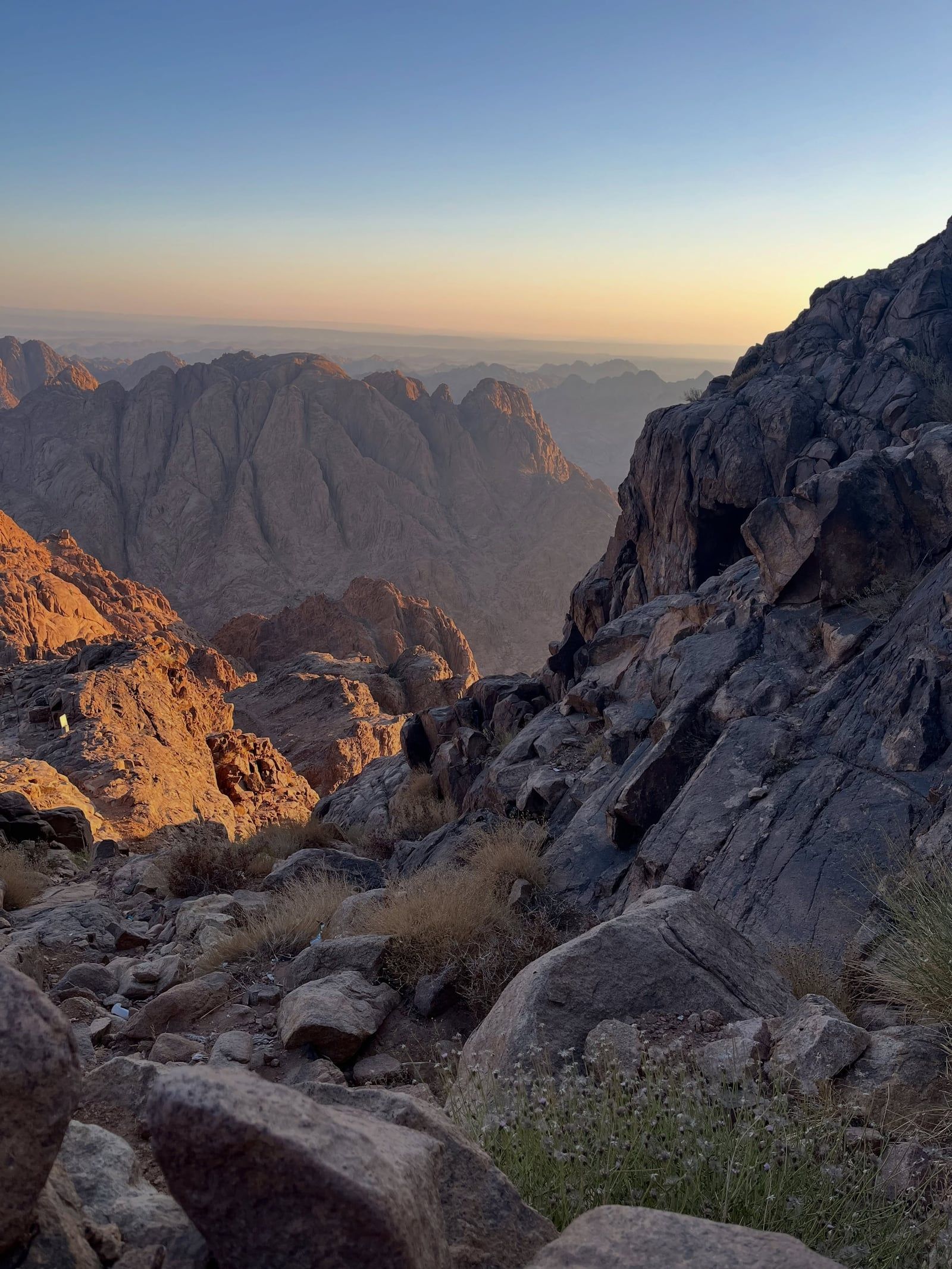
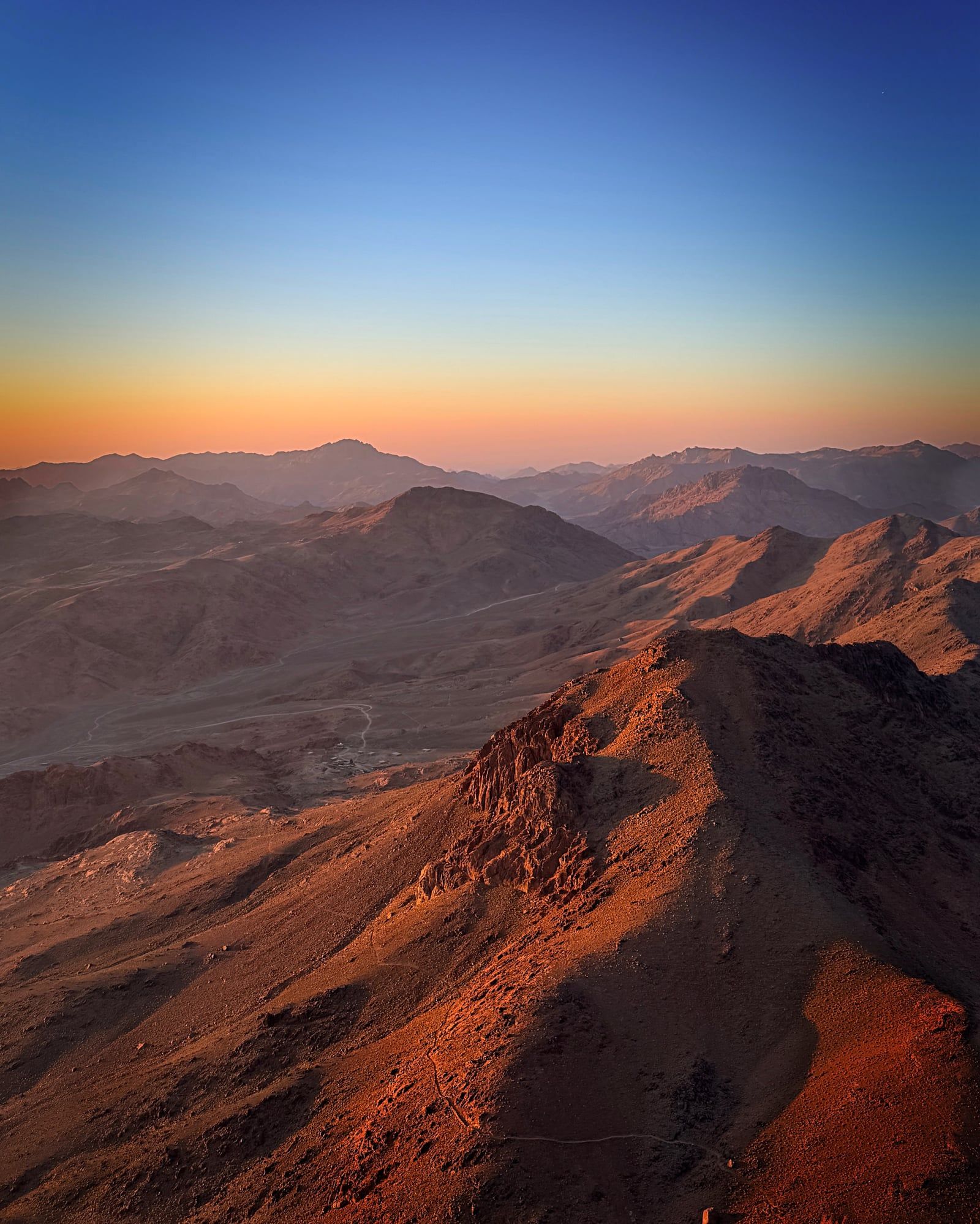
Mount Sinai is a slab of alkaline granite rising 2,285 m above sea level, one peak in the Sinai Massif's ring-complex country about 50 km inland from the Red Sea. The rock walls on the final stairway are close enough to touch on both sides. Loose gravel covers stretches of the lower path, which is where most twisted ankles happen.
Despite its fame, it's not the tallest thing in sight. Mount Catherine (2,629 m), Egypt's highest mountain, stands right beside it, and at least ten peaks in the massif top Mount Sinai — so the panorama, not the altitude, is the reward from the top. Two routes serve the summit. The Camel Path zigzags up on a well-graded incline over 2.5–3 hours, with camels and tea huts along the way. The Steps of Repentance go nearly straight up: 3,750 rough stone steps, about 2 hours for the fit, passing the Gate of Stephen and the Gate of the Law on the ancient Path of Moses. Camels stop at Elijah's Basin either way — the last 750 steps are on foot, always.
The whole mountain sits inside the Saint Catherine Protectorate, 60,100 hectares declared in 1988. Nubian ibex roam the high ground, and the Sinai Baton Blue — the world's smallest butterfly — lives here and essentially nowhere else. The high-desert climate swings hard: summit nights sit at 0–5°C in December–February while the base reaches 15–25°C by day, and even summer nights only manage 20–25°C up top. Pack for both ends of that range on any climb.
One mountain, three religions. Jews, Christians and Muslims all identify Jabal Musa as the place where Moses received the Ten Commandments, and the tradition has been pinned to this Egyptian peak since the 4th century. A minority theory argues for Jabal al-Lawz in Saudi Arabia, but every major Christian tradition and mainstream scholarship accept the Sinai site — and pilgrims have been walking up in the dark to watch sunrise from the summit for some 1,700 years.
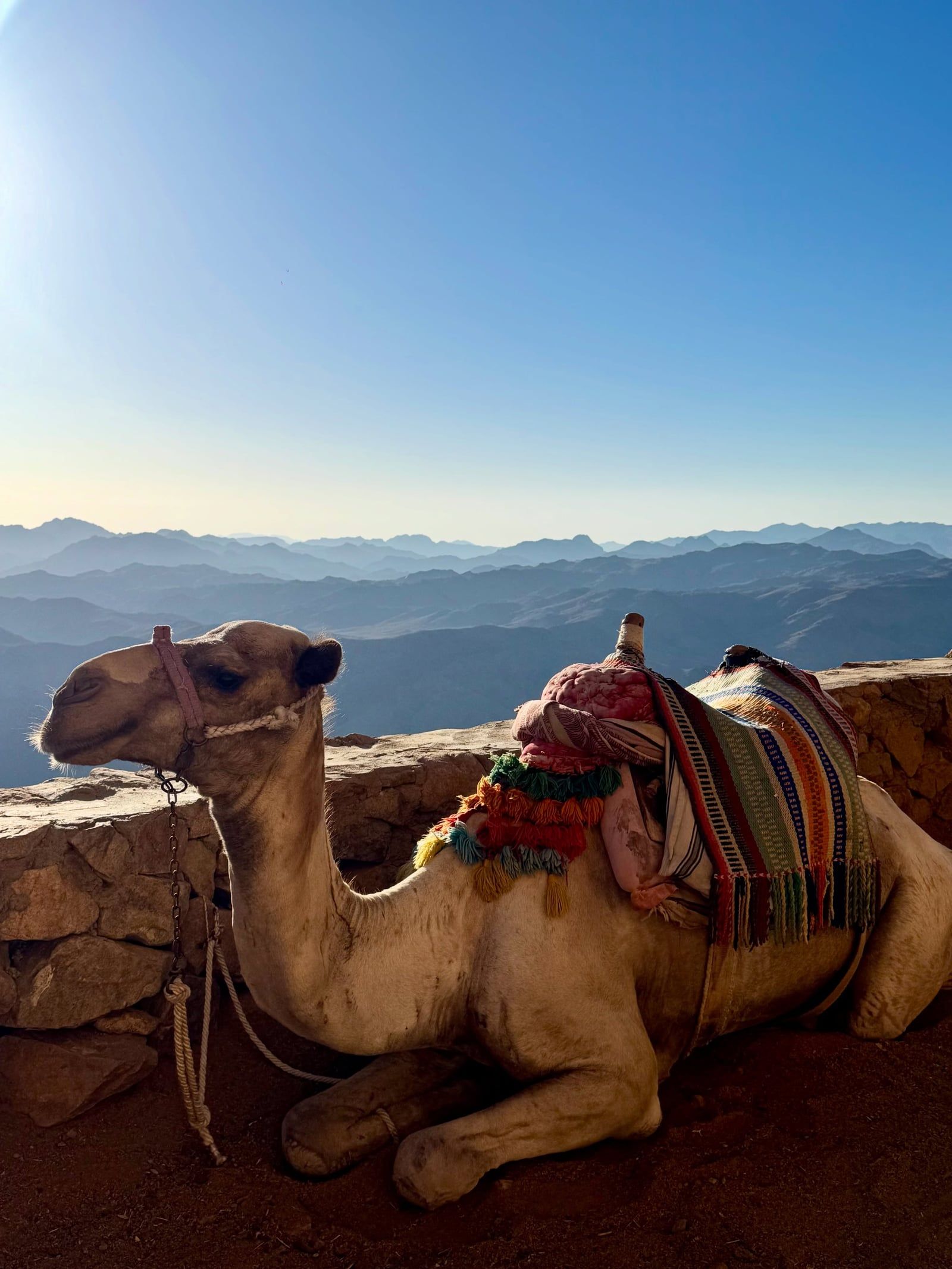
The mountain has local guardians, too. The Jabaliya Bedouin have watched over it for centuries, and today every legal climb is led by a licensed Jabaliya guide — unguided hiking is banned outright. Their presence is what makes the climb feel the way it does: mint tea at mountain huts, blankets for rent at 4 AM, camels hauling tired legs up the lower switchbacks.
At the foot sits the living heart of the site. Saint Catherine's Monastery still functions as an active Orthodox community with roughly 3,500 manuscripts and 2,000 icons in its care, including the shelves where the Codex Sinaiticus was found. Saint Catherine town exists because of the mountain, and its economy runs on pilgrims and hikers. Both the summit chapel and the 12th-century mosque hold prayers at dawn — visitors are asked to stay discreet while the sunrise crowd and the worshippers share the same plateau.
The Sinai Baton Blue, the smallest butterfly on Earth, lives in the Saint Catherine Protectorate around the mountain and is found almost nowhere else.
The Codex Sinaiticus, one of the oldest surviving Bibles, was discovered at Saint Catherine's Monastery, which still holds about 3,500 ancient manuscripts.
A 12th-century mosque and a small chapel share the summit plateau, so one mountain top serves Christian and Muslim worshippers side by side.
At least ten peaks in the Sinai Massif are higher than Mount Sinai, including neighbouring Mount Catherine (2,629 m), Egypt's highest mountain.
A single repentant monk carved the Steps of Repentance by hand in the 6th–7th centuries; 3,750 stone steps, still walkable today.
Permits for multi-day trekking, including the 200 km Sinai Trail, have not been issued since late 2024 — the summit climb is the main permitted walk.
The free 15-day stamp issued at Sharm el-Sheikh airport covers only Sharm, Dahab, Nuweiba and Taba — Saint Catherine lies outside it, so you need a full Egyptian visa (US$30 cash on arrival).
Mount Sinai (Jabal Musa) is in Egypt, in the south-central Sinai Peninsula, about 3 km from Saint Catherine town. It has been the traditional location since the 4th century CE. A minority theory proposes Jabal al-Lawz in Saudi Arabia, but mainstream scholars and all major Christian traditions accept the Egyptian site.
The ascent takes 1.5–3 hours depending on route and fitness — the Camel Path runs 2.5–3 hours, the Steps of Repentance about 2 hours. The full round trip covers 11.5 km with 700 m of elevation gain in roughly 3–4 hours, plus 30–60 minutes on the summit waiting for sunrise.
Yes. A locally licensed Bedouin guide from the Jabaliya tribe is compulsory, checked at the visitor centre before you start. The going rate is around EGP 800 (about US$16) as a flat fee for the whole group if you hire at the entrance.
The mountain itself has no ticket, but the mandatory guide runs about EGP 800 per group and camel rides EGP 250 to Elijah's Basin. Monastery entry is reported free by most recent visitors, though some tours collect €10 per person and a 2026 Egyptian fee list prices it at EGP 200 — budget up to €10 each to be safe. Organized tours from Sharm or Dahab cost €24–60 per person.
Sunrise falls around 6:00 AM, so hikers start walking between 1:00 and 2:00 AM and reach the top by 4–5 AM. Tours from Sharm el-Sheikh pick up around 8:00–8:30 PM; minibuses from Dahab leave around 11 PM.
In winter the summit sits at 0–5°C on night climbs, even when daytime temperatures at the base reach 15–20°C. Summer nights are milder at 20–25°C. Pack layers, a hat and gloves year-round, or rent a blanket from Bedouin vendors on the mountain.
Yes — camels carry riders or bags along the Camel Path as far as Elijah's Basin for about EGP 250 (some operators quote €20 each way). The final 750 stone steps to the summit must be climbed on foot, roughly 30–45 minutes.
Monday–Thursday and Saturday, roughly 9:00 AM to 12:00 noon. It closes on Fridays, Sundays and major Greek Orthodox feast days, and it can shut at short notice — the 2025 land dispute closed it for months — so check the current status before travelling.
The southern Sinai sites, including Saint Catherine and Mount Sinai, sit outside the do-not-travel zone covering North Sinai, and the US State Department confirms its embassy staff are cleared to visit. Expect numerous routine military checkpoints — one 2024 visitor counted twelve — keep your passport handy, and travel with a licensed tour rather than independently.
Yes, for this trip. The free entry stamp issued at Sharm el-Sheikh airport (valid up to 15 days) covers only Sharm, Dahab, Nuweiba and Taba, and Saint Catherine is outside those zones. You need a full Egyptian visa: US$30 in cash on arrival, or US$36 through the digital system available in Cairo from 1 August 2026.
Browse verified tours with free cancellation and instant confirmation.
Find Tours